
Documentation Discipline Reduces Risk
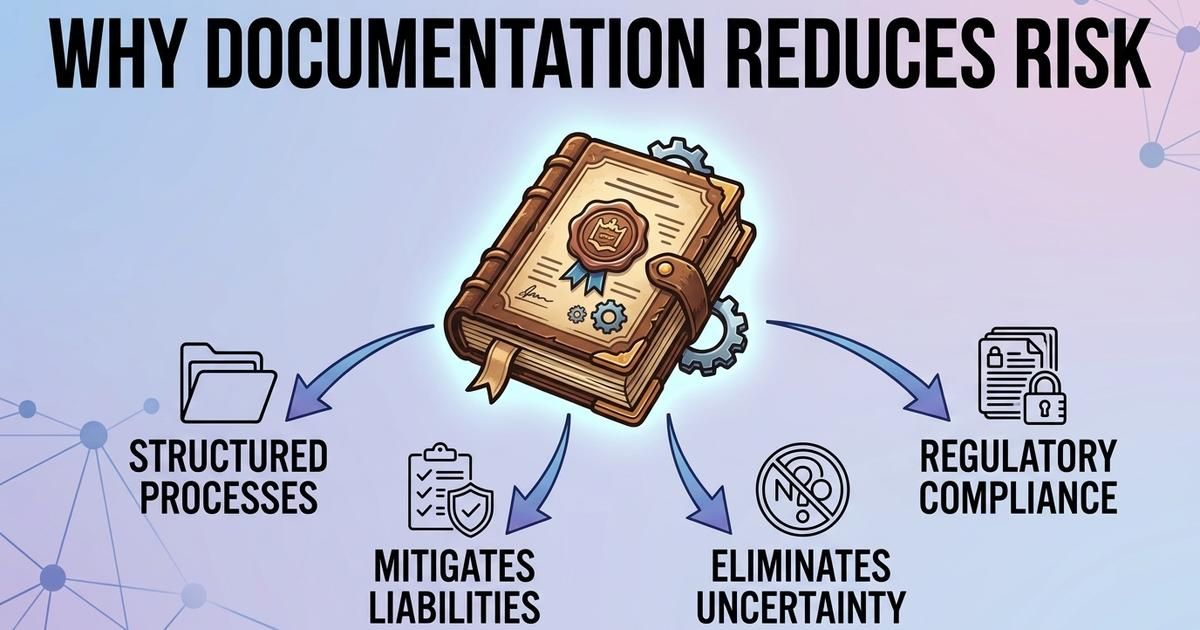

Why Documentation Discipline Reduces Business Risk (Not Just Onboarding Time)
For a mid-sized engineering team, poor documentation quietly costs between $500,000 and $2 million a year once lost productivity, delayed projects, and rework are added up. Almost none of that shows up on a budget line labeled "documentation" — which is exactly why it never gets fixed.
Want to know what documentation gaps are actually costing your organization?
Documentation has an image problem in most organizations: it's treated as a nice-to-have, something engineers complain about but nobody owns, a task that will supposedly get addressed "when there's more time." That time never fully arrives, and the reason isn't laziness — it's that documentation debt is genuinely invisible in the way it accumulates, compounding quietly rather than announcing itself the way a missed deadline does.
Stats That Matter
- Poor documentation can cost a mid-sized engineering team $500,000 to $2 million annually once lost productivity, delayed projects, context switching, and rework are combined.
- 69% of developers lose 8 or more hours per week to inefficiencies, with poor or missing documentation cited as a direct productivity drain by over a third of developers.
- A landmark NIST study found poor software documentation and inadequate technical support contributed an estimated $31 billion in annual costs to the U.S. economy, with documentation-related errors consuming roughly 15% of total software development budgets.
Why This Is a Risk Problem, Not Just an Efficiency Problem
The efficiency case for documentation is well established — faster onboarding, less time re-explaining the same thing repeatedly, fewer engineers blocked waiting on someone else's knowledge. But framing documentation purely as an efficiency issue understates the real stakes for leadership, because the deeper risk is about what happens when the person holding undocumented knowledge simply isn't available anymore.
When an employee leaves, they take more than technical skills with them — they take relational capital, undocumented decisions, and institutional memory about why systems were built the way they were. This loss of organizational memory makes a company measurably more prone to repeating past mistakes, because the reasoning behind previous decisions leaves with the person who made them rather than staying accessible to whoever comes next.
Why the Cost Stays Hidden Until It's Large
Documentation debt shares a defining characteristic with the technical debt and code quality issues covered elsewhere in this series: it rarely appears as a single visible failure on a budget sheet. It shows up instead as small, repeated losses — a blocked deployment here, ten minutes lost searching for an answer there, a support queue that grows because the product shipped faster than the documentation describing it changed. Individually, none of these register as a problem worth escalating. Accumulated over a quarter, they represent real money and materially slower delivery.
This is precisely why leadership frequently misdiagnoses the underlying cause. When engineering feels slower than it should be, when onboarding takes longer than expected, when people leave and take critical knowledge with them, the instinctive leadership response is "we need more people" or "we need better tools." The actual driver, in a meaningful share of cases, is documentation debt sitting underneath all three symptoms — invisible to standard reporting, but very visible in its downstream effects.
Why This Compounds Faster Than Technical Debt
Documentation debt has a specific dynamic that makes it particularly dangerous: unlike code, which at least still runs (even if poorly structured), undocumented knowledge simply disappears the moment the person holding it is unavailable — on leave, moved to a different team, or gone entirely. Code with poor structure is a known, fixable liability. Undocumented knowledge that only exists in one person's head is a liability that can become permanently unrecoverable without warning.
This is why new hires in poorly documented organizations end up learning "whichever version of the system the loudest teammate remembers" — a genuinely risky way to transmit institutional knowledge, since it depends entirely on whoever happens to be present and vocal, rather than on an accurate, durable record.
The Business Case Leadership Should Actually Use
Onboarding speed has a direct, measurable revenue link. Organizations that implement structured knowledge management have cut onboarding time roughly in half in documented cases — a change with a direct impact on how quickly new team members reach full productivity and start generating value, not just an HR convenience metric.
Documentation quality is a leading indicator, not a lagging one. Financial and delivery metrics tell you what already happened. Metrics like time-to-full-productivity and internal knowledge accessibility tell you what's about to happen to delivery speed and risk exposure before it shows up in a missed deadline.
Knowledge loss from turnover is a quantifiable, budgetable risk, not an unavoidable cost of doing business. Structured mentorship, knowledge-focused exit processes that go beyond a standard exit interview, and disciplined documentation practices all directly reduce how much institutional knowledge walks out the door with a departing employee — and this is meaningfully more achievable and less costly than trying to reconstruct that knowledge after it's already gone.
Why AI Makes This More Urgent, Not Less
There's a temptation to assume AI tools solve the documentation problem by generating documentation automatically or by letting engineers query a codebase directly instead of reading written docs. In practice, AI-generated documentation without a review gate tends to accelerate exactly the failure pattern that causes doc rot in the first place — content that's produced quickly but drifts out of sync with the actual system, creating a false sense that documentation exists and is current when it's neither reliable nor accurate. The underlying discipline of keeping documentation synchronized with the system it describes still requires deliberate process, regardless of what tool produces the initial draft.
What Leadership Should Actually Do
Ask what percentage of recent engineering delays trace back to missing or outdated documentation. Most leadership teams have never asked this question directly, and the answer is frequently larger than assumed once it's actually investigated.
Treat documentation as tied to specific business risk, not as a generic engineering best practice. Framing it around onboarding speed, knowledge retention risk, and delivery predictability makes the business case concrete rather than abstract.
Require that documentation updates ship alongside the change they describe, not as a separate, deferrable task. Documentation that's decoupled from the change process is documentation that reliably falls behind, regardless of how much initial effort went into writing it.
Key Takeaways
- Poor documentation can cost a mid-sized engineering team $500,000 to $2 million annually, and developers lose close to a full workday every week to related inefficiencies.
- The deeper risk isn't efficiency — it's that undocumented knowledge disappears permanently and unpredictably when the person holding it becomes unavailable.
- Documentation debt stays hidden in small, repeated losses rather than a single visible failure, which is why leadership frequently misdiagnoses slow delivery as a headcount problem instead.
- Structured documentation and knowledge management practices have been shown to cut onboarding time roughly in half in documented cases, with a direct link to faster time-to-productivity.
- AI-generated documentation without a review and synchronization process can accelerate documentation drift rather than solving it — the underlying discipline still requires deliberate process.
What to Do Next
If your organization has never measured how much time is lost to missing or outdated documentation, that's a strong sign the cost is larger than anyone currently assumes — and it's a fixable discipline gap, not a headcount problem.
I work with a trainer who specializes in exactly this: helping engineering and leadership teams build the documentation discipline that reduces both operational drag and real business risk. If this is on your radar for the next quarter, call or contact me and I'll help you get started.